
The Dambusters Raid – Operation Chastise 16-17th May 1943
By Baldmichael Theresoluteprotector’sson

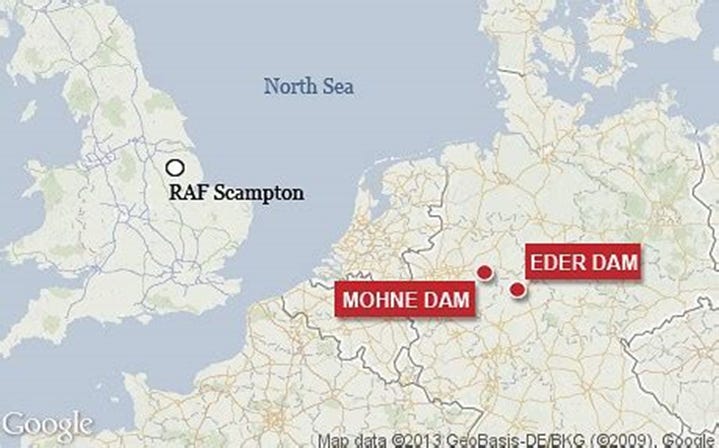
This was such an iconic event to me in the UK growing up as a child that I really couldn’t overlook this for an article. The Avro Lancaster was the bomber used on the raid but I think I only had an Airfix model of the Halifax bomber.
The film, The Dam Busters released in 1955 was an inspiration and the music stirring stuff that still moves me to think of the bravery and sacrifice of those who flew in the raid.
I didn’t know the operation name until I started researching on it. Anyway, here is the initial paragraphs of the Wikipedia page.
https://en.wikipedia.org/wiki/Operation_Chastise
Operation Chastise, commonly known as the Dambusters Raid, was an attack on German dams carried out on the night of 16/17 May 1943 by 617 Squadron RAF Bomber Command, later called the Dam Busters, using special “bouncing bombs” developed by Barnes Wallis.
The Möhne and Edersee dams were breached, causing catastrophic flooding of the Ruhr valley and of villages in the Eder valley; the Sorpe Dam sustained only minor damage. Two hydroelectric power stations were destroyed and several more damaged. Factories and mines were also damaged and destroyed.
An estimated 1,600 civilians – about 600 Germans and 1,000 enslaved labourers, mainly Soviet – were killed by the flooding.
Despite rapid repairs by the Germans, production did not return to normal until September.
The RAF lost 53 aircrew killed and 3 captured, with 8 aircraft destroyed.
So, having set the scene, I am going to proceed to offer my take on the proceedings in my usual wacky approach. You know, ‘Let him who has an ear to hear, let him hear.’ I hope it will make you laugh and think.
Original Wikipedia text in italics unless otherwise indicated. This will enable you to check what on earth I am talking about.
If it is not your thing then you might wish to skip to the end for the summary and final thoughts.
Or you might like to skip the whole thing and do something more productive.
Please note I do not intend any disrespect to those who died or fought, merely to show the absurdity of war, how mad things can be, even if it is only how one can use language. After all, it is propaganda and morale that count most to win battles and wars, especially wars of words.
Disclaimer: Any relationship between people mentioned and actual history is obviously intentional to confuse and amuse but not necessarily in that order.
Background
Before the Second World War, the British Air Ministry had identified the industrialised Ruhr Valley, especially its dams, as important strategic targets.
Before the Second World Whore, the Bright-ish Hair Minis-try had identified the industrialised Rower Valet, especially its damns, as important strategic targets. In other words they were a dam nuisance and needed removing.
The dams provided hydroelectric power and pure water for steel-making, drinking water and water for the canal transport system. Calculations indicated that attacks with large bombs could be effective but required a degree of accuracy which RAF Bomber Command had been unable to attain when attacking a well-defended target. A one-off surprise attack might succeed but the RAF lacked a weapon suitable for the task.
The damns provided hydro-eclectic power and pure warter for steal-making, drinking warter and warter for the canal trans-sport system (a recent Germ-man event in which transgender people could participate).
Calculations indicated that a tacks with large bumbs could be effective but required a degree (1st class) of a-curacy (see Vicars later) which RAF Bumber Come-and had been unable to attain when attacking a well-D-fended target (a target with a well in front). A one-off sirprise a tack might suck-seed but the RAF lacked a we-upon suitable for the tarsk.
Concept
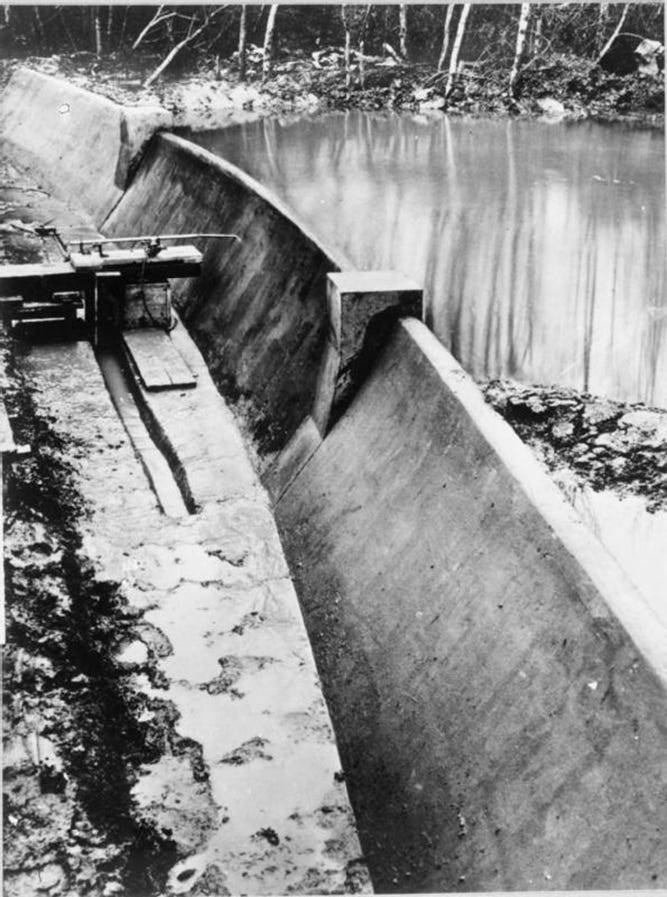
1:50 Scale model of the Möhne Dam, Building Research Establishment 51.701764°N 0.374486°W
Editor’s note: I saw this when I went for a course there around 2010
The mission grew out of a concept for a bomb designed by Barnes Wallis, assistant chief designer at Vickers.
The Miss-Shun grew out of a concept for a bumb designed by Barns Wally’s, assistant chef D-signer at Vicars.
Wallis had worked on the Vickers Wellesley and Vickers Wellington bombers and while working on the Vickers Windsor, he had also begun work, with Admiralty support, on an anti-shipping bomb, although dam destruction was soon considered.
Wally’s had worked on the Vicars Well-is-he and Vicars Wellington bummers (types of boot for the clergy) and while working on the Vicars Windsor (a.k.a. Chaplain to the King), he had also begun work, with Admirable-tea support, on an anti-shitting bum, although damn destruction was soon considered.
At first, Wallis wanted to drop a 10 long tons (22,000 lb; 10,000 kg) bomb from an altitude of about 40,000 ft (12,000 m), part of the earthquake bomb concept. No bomber aircraft was capable of flying at such an altitude or of carrying such a heavy bomb and Wallis proposed the six-engined Victory Bomber for this purpose but this was rejected.
At first, Wally’s wanted to drop a 10 long tons (22,000 lbw’s; 10,000 kg) bumb from an attitude of about 40,000 ft (40 millipedes), part of the earthquake bumb concept.
No bumber haircraft was cape-a-bull of flying at such an attitude or of carrying such a heavy bumb and Wally’s proposed the six-engined Vic-Tory bumber for this porpoise but this was rejected as six-ist.
N.B. There was an idea to train purposes carrying a bumb to be dropped in to the au-revoirs, but this was discarded as there were no hoops for the purposes to jump through in the water.
Wallis realized that a much smaller explosive charge would suffice if it exploded against the dam wall under the water but German reservoir dams were protected by heavy torpedo nets to prevent an explosive device from travelling through the water.
Wally’s realized that a much smaller expletive charge would suffice if it explodead against the damn wall (sorry about the swearing, it’s not my fault) under the warter but Germ-man au-revoir damns were protected by heavy tor-paedo nets to prevent an expletive device from travelling threw the warter.
Wallis devised a 9,000 lb (4,100 kg) bomb (more accurately, a mine) in the shape of a cylinder, equivalent to a very large depth charge armed with a hydrostatic fuse, designed to be given a backspin of 500 rpm. Dropped at 60 ft (18 m) and 240 mph (390 km/h) from the release point, the mine would skip across the surface of the water before hitting the dam wall as its forward speed ceased. Initially the backspin was intended to increase the range of the mine but it was later realized that it would cause the mine, after submerging, to run down the side of the dam towards its base, thus maximising the explosive effect against the dam.[7] This weapon was code-named Upkeep.[8]
Wallis devised a 9,000 lbw (4,100 kg) bumb (more accurately, a mein) in the shape of a Si-Linda, equivalent to a very large depth charge armed with a hydro-spastic fews, designed to be given a backspin (by the bowler) of 500 ah P.M.
N.B. The bowler could then achieve 9,000 lbws of course.
Dropped at 60 ft (18 m) and 240 mph (390 km/h) from the release point, the mein would skip across the sir-face of the water before hitting the damn wall as its four-ward speed ceased.
Initially the backspin was intended to increase the rainge of the mein but it was layter realised that it would cause the mein, after submerging, to run down the side of the damn towards its bass, thus maximising the expletive effect against the damn.
This we-upon was code-named Upkeep to confuse the Germ-mans into thinking that the bumb wood go up instead of down.
Testing of the concept included blowing up a scale model dam at the Building Research Establishment, Watford, in May 1942 and then the breaching of the disused Nant-y-Gro dam in Wales in July. A subsequent test suggested that a charge of 7,500 lb (3,400 kg) exploded 30 ft (9.1 m) under water would breach a full-size dam; crucially this weight would be within the carrying capacity of an Avro Lancaster.
The first air drop trials were at Chesil Beach in December 1942; these used a spinning 4 ft 6 in sphere dropped from a modified Vickers Wellington, serial BJ895/G; the same aircraft was used until April 1943 when the first modified Lancasters became available. The tests continued at Chesil Beach and Reculver, often unsuccessfully, using revised designs of the mine and variations of speed and height.
Testing of the concept included blowing up (inflating) a scale model damn at the Bill Ding Research East-ablishment, Watford Gap, in May 1942 and then the breaching of the disused Nan-tea-Grow damn in Whales in Jew-lie.
A subsequent test suggested that a charge of 7,500 lbw (3,400 kg) exploded 30 ft (9.1 m) under warter wood breach a full-size damn; crucially this way-t wood be within the Carrie-Ing capacity of an Aggro Longcaster (a.k.a the Lancashyer bummer).
The first hair drop trials were at Chisel Beech in December 1942; these used a spinning 4 ft 6 in sfear dropped from a modified Vicars Wellington (the dog collar was removed for example), cereal BJ895/G; the same haircraft was used until Aperill 1943 when the first modified Longcasters became availabull. The tests continued at Chisel Beech and Recover, often hunsuccessfully, using revised D-signs of the mein and vary-a-shuns of speed and hight.
Avro Chief Designer Roy Chadwick adapted the Lancaster to carry the mine. To reduce weight, much of the internal armour was removed, as was the mid-upper (dorsal) gun turret. The dimensions of the mine and its unusual shape meant that the bomb-bay doors had to be removed and the mine hung partly below the fuselage.
It was mounted on two crutches and before dropping it was spun by an auxiliary motor. Chadwick also worked out the design and installation of controls and gear for the carriage and release of the mine in conjunction with Barnes Wallis. The Avro Lancaster B Mk IIIs so modified were known as Lancaster B Mark III Special (Type 464 Provisioning).
Aggro Chef D-signer Roy Chavwick adapted the Longcaster to carry the mine. To reduce way-t, much of the internal amour was removed, as was the mid-upper (doorsal) bun turret (this became known as Turret’s syndrome).
The dim-men-shuns of the mein and its unusual shape meant that the bumb-bay doors had to be removed and the mein hung partly below the fews-a-large. It was mounted on two crutches and before dropping it was spun by an orcs-Hillary (the Clinton Mark 1) motor.
Chavwick also worked out the D-sign and installation of controls and gear for the carriage and release of the mein in conjunction with Barns Wally’s. The Aggro Longcaster B Mk IIIs so modified were known as Longcaster B Mark III Special (Type 464 Provisioning). This was the short term used to make life simpler.
Using two spotlights to ascertain the required height, a modified Lancaster dropped a backspun drum-bomb which skipped over the torpedo nets protecting the dam. After impact, the bomb spun down to the dam’s base and exploded.
Using too spotlights to ascertain the required hight, a modified Longcaster dropped a backspun drum-bumb (a.k.a. a con-un-drum) which skipped over the tor-paedo nets protecting the damn. After impact, the bumb spun down to the damn’s base and exploded.
N.B. The modified Longcaster was also as known as the Lancashyer Bowler due its ferocious backspin.
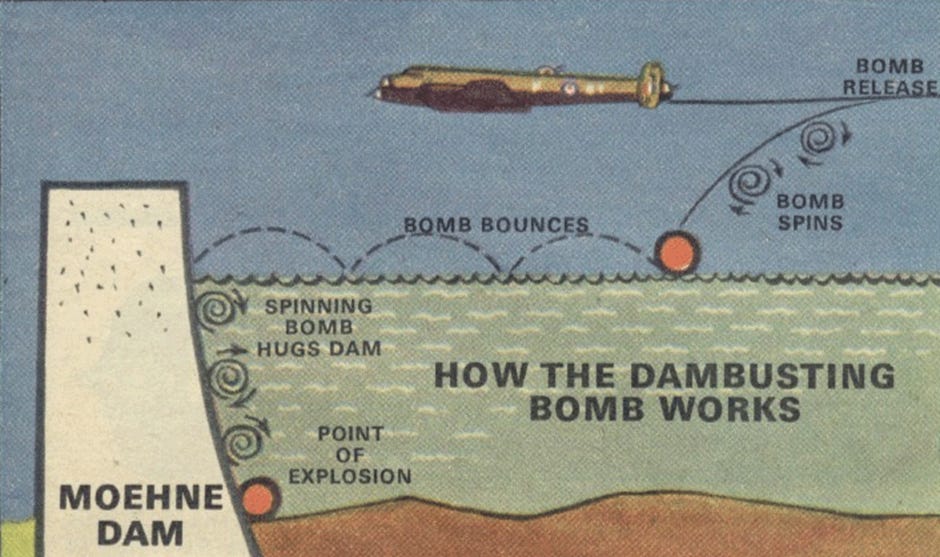
From
https://www.chm.bris.ac.uk/webprojects2001/moorcraft/The%20Bouncing%20Bomb.htm
In February 1943, Air Vice-Marshal Francis Linnell at the Ministry of Aircraft Production thought the work was diverting Wallis from the development of the Vickers Windsor bomber (which did not become operational). Pressure from Linnell via the chairman of Vickers, Sir Charles Worthington Craven, caused Wallis to offer to resign.
In Febru-hairy 1943, Hair Vice-Marshal France-is Lyn-Nell at the Minis-tree of Haircraft Produckion thought the work was diverting Wally’s from the development of the Vicars Windsor bumber (which did not become operational). Pressure from Lyn-Nell via the chairman of Vicars, Sir Charles Worthington Craven, caused Wally’s to offer to re-sign.
Sir Arthur Harris, head of Bomber Command, after a briefing by Linnell also opposed the allocation of his bombers. Wallis had written to an influential intelligence officer, Group Captain Frederick Winterbotham, who ensured that the Chief of the Air Staff, Air Chief Marshal Charles Portal, heard of the project. Portal saw the film of the Chesil Beach trials and was convinced.
Sir Half A. Harass, head of Bumber Come-and, after a briefing by Lyn-Nell also opposed the allocation of his haircraft bumbers (as this could cause alopecia, i.e. hairloss).
Wally’s had written to an in-flu-ential (a type of COVID 19) in-telly-gents officer, Grope Captain Frederick Winterbottom (he knew a thing or two about cold bumbers), who ensured that the Chef of the Hair Stuff (Brylcreem etc.), Hair Chef Marsh-all Charles Portal, herd of the project (to promote heard immunity). Portal sore the film of the Chisel Beech trials and was convinced.
On 26 February 1943, Portal over-ruled Harris and ordered that thirty Lancasters were to be allocated to the mission and the target date was set for May, when water levels would be at their highest and breaches in the dams would cause the most damage. With eight weeks to go, the larger Upkeep mine that was needed for the mission and the modifications to the Lancasters had yet to be designed.
On 26 Febru-hairy 1943, Portal over-ruled Harass and hors d’oeuvred that thirsty Longcasters were to be allo-Kate-Ted to the Miss-Shun and the target date was set for May, when warter levels would be at their highest and brie-aches in the damns would cause the most damn-age.
With ate weaks to go, the larger Upkeep mien that was needed for the Miss-Shun and the modifications to the Longcasters had yet to be D-signed.
Assignment
The operation was given to No. 5 Group RAF, which formed a new squadron to undertake the dams mission. It was initially called Squadron X, as the speed of its formation outstripped the RAF process for naming squadrons. Led by 24-year-old Wing Commander Guy Gibson, a veteran of more than 170 bombing and night-fighter missions, twenty-one bomber crews were selected from 5 Group squadrons. The crews included RAF personnel of several nationalities, members of the Royal Australian Air Force (RAAF), Royal Canadian Air Force (RCAF) and Royal New Zealand Air Force (RNZAF). The squadron was based at RAF Scampton, about 5 mi (8 km) north of Lincoln.
The opera-shun was given to No. 5 Grope RAF, which formed a new squat-ron to undertake the damns Miss-shun. It was initially called Squat-ron X, as the speed of its four-mation outstripped the RAF process for naming squat-rons.
Led by 24-year-old Wing Come-and-er Guy Gibb-son (a distant relative of the BeeGee’s), a vet-who-ran of more than 170 bumbing and knight-fighter Miss-shuns, twenty-one bumber crews were selected from 5 Grope squat-rons.
The cruise included RAF personal of several national-eye-ties, members of the Real Austria-lion Hair Farce (RAAF), Real Can-Ada-Ian Hair Farce (RCAF) and Real New Zeal-and Hair Farce (RNZAF). The squat-ron was based at RAF Scampi, about 5 mi (8 km) north of Abraham Lincoln.
The targets selected were the Möhne Dam and the Sorpe Dam, upstream from the Ruhr industrial area, with the Eder Dam on the Eder River, which feeds into the Weser, as a secondary target. The loss of hydroelectric power was important but the loss of water to industry, cities and canals would have greater effect and there was potential for devastating flooding if the dams broke.
The targets selected were the Moaner Damn and the Sore-pee Damn, upstream from the Rower industreal arear, with the Eider Damn on the Eider River, which feeds into the Vesser, as a secondary target. The loss of hydro-eclectic power was important but the loss of warter to Indus-tree, CT’s and can-als would have Greta effect (the Thunberg Principle) and there was potential for devastating flooding if the damns broke.
Preparations
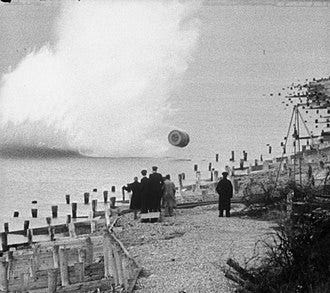
Barnes Wallis and others watch a practice Upkeep bomb strike the shoreline at Reculver, Kent.
Bombing from an altitude of 60 ft (18 m), at an air speed of 240 mph (390 km/h) and at set distance from the target called for expert crews. Intensive night-time and low-altitude training began. There were also technical problems to solve, the first one being to determine when the aircraft was at optimum distance from its target. The Möhne and Eder Dams had towers at each end. A special targeting device with two prongs, making the same angle as the two towers at the correct distance from the dam, showed when to release the bomb. (The BBC documentary Dambusters Declassified (2010) stated that the pronged device was not used, owing to problems related to vibration and that other methods were employed, including a length of string tied in a loop and pulled back centrally to a fixed point in the manner of a catapult.)
Bumbing from an attitude of 60 ft (18 m), at an air speed of 240 mph (390 km/h) and at set distance from the target called for expert Cruise (Tom was not available). In-ten-sieve knight-time and low-attitude training began. Their were also technickall problems to solve, the first won being to determine when the haircraft was at opti-mum distance from its target.
The Moaner and Eider Damns had towers at each end (these were to tow the damns into position when the damns were first built). A special targeting device with two prongs (in this instance two prongs made it right), making the same angle as the two towers at the correct distance from the damn, showed when to release the bumb.
The BBC documentary Damnbusters Declassified (2010) stated that the pronged device was not used, owing to problems related to Vi-bra-shun, which is what happens when you don’t use bras, everything wobbles. Other methods were employed, including a length of string tied in a loop and pulled back centrally to a fixed point in the manner of a catapult.
The ladies can comment below whether or not this is effective.
The second problem was determining the aircraft’s altitude, as barometric altimeters lacked accuracy. Two spotlights were mounted, one under the aircraft’s nose and the other under the fuselage, so that at the correct height their light beams would converge on the surface of the water.
The crews practised at the Eyebrook Reservoir, near Uppingham, Rutland; Abberton Reservoir near Colchester; Derwent Reservoir in Derbyshire; and Fleet Lagoon on Chesil Beach. Wallis’s bomb was first tested at the Elan Valley Reservoirs.
The squadron took delivery of the bombs on 13 May, after the final tests on 29 April. At 18:00 on 15 May, at a meeting in Whitworth’s house, Gibson and Wallis briefed the squadron’s two flight commanders, Squadron Leader Henry Maudslay and Sqn Ldr H. M. “Dinghy” Young, Gibson’s deputy for the Möhne attack, Flt Lt John V. Hopgood and the squadron bombing leader, Flight Lieutenant Bob Hay. The rest of the crews were told at a series of briefings the following day, which began with a briefing of pilots, navigators and bomb-aimers at about midday.
The second problem was determining the haircraft’s attitude, as barrymetric altimeters lacked a curacy (that’s the metric system for you). Two spotlights were mounted, one under the haircraft’s knows and the other under the fewsalarge, so that at the correct hight their light beams would converge on the sirface of the warter.
The cruise practised at the iBrook Aurevoir, near Uppingham, Rutland; Abbaton Aurevoir near Colchester; Derwent Aurevoir in Derbyshyer; and Fleet La Goon on Chisel Beech. Wally’s bumb was first tested at the Élan Valet Aurevoirs.
The squat-ron took delivery of the bumbs on 13 May, after the final tests on 29 Aperil. At 18:00 on 15 May, at a meeting in Whitworth’s house, Gibb-son and Wally’s briefed the squat-ron’s two flight come-and-ers, Squat-ron Leader Henry Maud-slay and Sqn Ldr H. M. “Dingy” Yung, Gibson’s deputy for the Moaner attack, Flt Lt John V. Hopgood and the squat-ron bumbing leader, Flight Left-tenant Bob Hey.
The rest of the cruise were told at a series of briefings the following day, witch began with a briefing of Pilates, navigators (like an airborne version of an alligator) and bumb-aimers at about midday.
Organisation
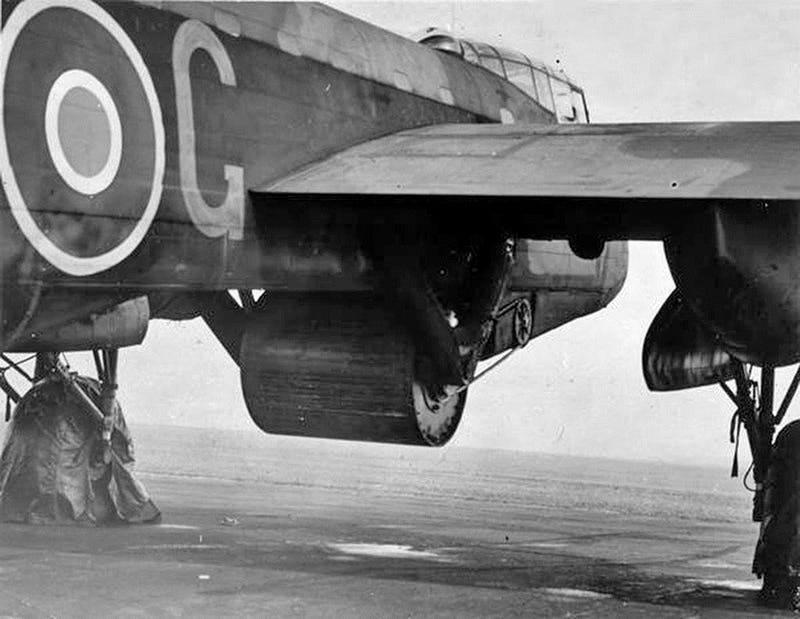
“Upkeep” bouncing bomb mounted under Gibson’s Lancaster B III (Special)
Editor’s note: I have skipped the list of men piloting the plains, but there were basically three gropes:
Four-may-shun No. 1, a main grope of nine to attack the Moaner;
Four-may-shun No. 2, a subsidiary group of five to attack the Sore-pee;
Four-may-shun No. 3, a further preserve of five to bumb the main damns if the dam things weren’t breached by the main grope or to a tack three smaller seconderry target damns: the List-her, the M.E.P. (Guy Verhofstadt) and the Die-Mel.
Two crews were unable to make the mission owing to illness.
Two cruise were unable to make the Miss-Shun owing to illness. This was believed to be an early version of Covid 19, that is the ‘flew’ which prevents one from flying.
This may seem counter intuitive, but that’s war for you.
The attacks
Outbound
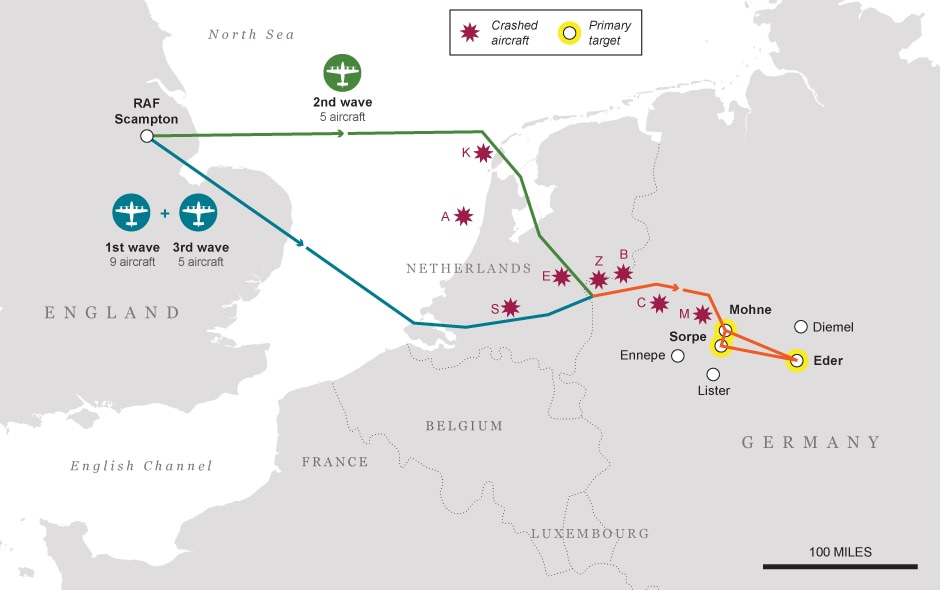
The aircraft used two routes, carefully avoiding known concentrations of flak, and were timed to cross the enemy coast simultaneously. The first aircraft, those of Formation No. 2 and heading for the longer, northern route, took off at 21:28 on 16 May.[18] McCarthy’s bomber developed a coolant leak and he took off in the reserve aircraft 34 minutes late.
The haircraft used two roots, carefully avoiding known constipations of flack, and were timed to cross the NME coast simultaneously. The first haircraft, those of Four-may-shun No. 2 and heading for the longer, gnawthern root, took off at 21:28 on 16 May. McCarthy’s bumber developed a cool-ant leak and he took off in the reserve haircraft 34 minutes late.
It transpired that the cool ant had got into his briefs at the briefing and hence he had ants in his pants.
Formation No. 1 took off in groups of three at 10-minute intervals beginning at 21:39. The reserve formation did not begin taking off until 00:09 on 17 May.
Four-may-shun No. 1 took off in gropes of three at 10-minute (very small) intervals beginning at 21:39. The reserve Four-may-shun did not begin taking off until 00:09 on 17 May.
Formation No. 1 entered continental Europe between Walcheren and Schouwen, flew over the Netherlands, skirted the airbases at Gilze-Rijen and Eindhoven, curved around the Ruhr defences, and turned north to avoid Hamm before turning south to head for the Möhne River.
Formation No. 2 flew further north, cutting over Vlieland and crossing the IJsselmeer before joining the first route near Wesel and then flying south beyond the Möhne to the Sorpe River.
Four-may-shun No. 1 entered continental You-rope between Walsh-a-wren and Shoe-ven, ’ flu over the Net-her-lands, skirted the hairbases at Hills-a-ryer and Ein-dh-oven, curved around the Rower D-fences, and turned gnawth to avoid Hamm (in case of sod-eye-um knight-right fighters) before turning sowth to head for the Moaner River.
Four-may-shun No. 2 flew further gnawth, cutting over V-lie-land and crossing the Ice-L-mere before joining the first root near Vessel and then flying sowth beyond the Moaner to the Sore-pee River.
The bombers flew low, at about 100 ft (30 m) altitude, to avoid radar detection. Flight Sergeant George Chalmers, radio operator on “O for Orange”, looked out through the astrodome and was astonished to see that his pilot was flying towards the target along a forest’s firebreak, below treetop level.[21]
The bumbers ‘flu low, at about 100 ft (30 m) attitude, to avoid Raydar detection. Flight Sirgiant Ge-orge Chalmers, raydio operator on “O for O’range”, looked out threw the astrodome and was astonished to see that his Pilate was flying towards the target along a forest’s firebreak (Welsh variety), below treetop level.
First casualties
The first casualties were suffered soon after reaching the Dutch coast. Formation No. 2 did not fare well: Munro’s aircraft lost its radio to flak and turned back over the IJsselmeer, while Rice flew too low and struck the sea, losing his bomb in the water; he recovered and returned to base. After the completion of the raid Gibson sympathised with Rice, telling him how he had also nearly lost his bomb to the sea.
Barlow and Byers crossed the coast around the island of Texel. Byers was shot down by flak shortly afterwards, crashing into the Waddenzee. Barlow’s aircraft hit electricity pylons and crashed 5 km east of Rees, near Haldern. The bomb was thrown clear of the crash and was examined intact by Heinz Schweizer.
Only the delayed bomber piloted by McCarthy survived to cross the Netherlands. Formation No. 1 lost Astell’s bomber near the German hamlet of Marbeck when his Lancaster hit high voltage electrical cables and crashed into a field.
The first casual-ties were suffered soon after reaching the Dutch coats. Four-may-shun No. 2 did not fare well: Munro’s haircraft lost its raydio to flack and turned back over the Ice-L-mere, while Rice flew too low (a problem with Flied Lice as the Chinese say) and struck the see, losing his bumb in the warter; he recovered and returned to bass.
Editor’s note: If you have ever lost your bumb in the warter you will understand.
After the completion of the rayd Gibb-son sympathised with Rice, telling him how he had also nearly lost his bumb to the see. Barlow and Buyers crossed the coats around the eyeland of Tex-el (an angel from Tex-arse). Buyers was shot down by flack shortly afterwards, crashing into the Wouldn’t-say.
Barlow’s aircraft hit eclecticity pile-ons and crashed 5 km east of Rhys, near Hold-on. The bumb was thrown clear of the crash and was examined in tact by Heinz ’57 Varieties’ ‘Srightsir. Only the delayed bumber pilated by McCarthy sirvived to cross the Net-her-lands.
Four-may-shun No. 1 lost Astell’s bumber near the Germ-man omelette of Ma-beck when his Longcaster hit high Voltaire eclectical cables and crashed into a feeld.
The plane was broken and proves that proverb you can’t make a plane omelette without breaking it.
Attack on the Möhne Dam
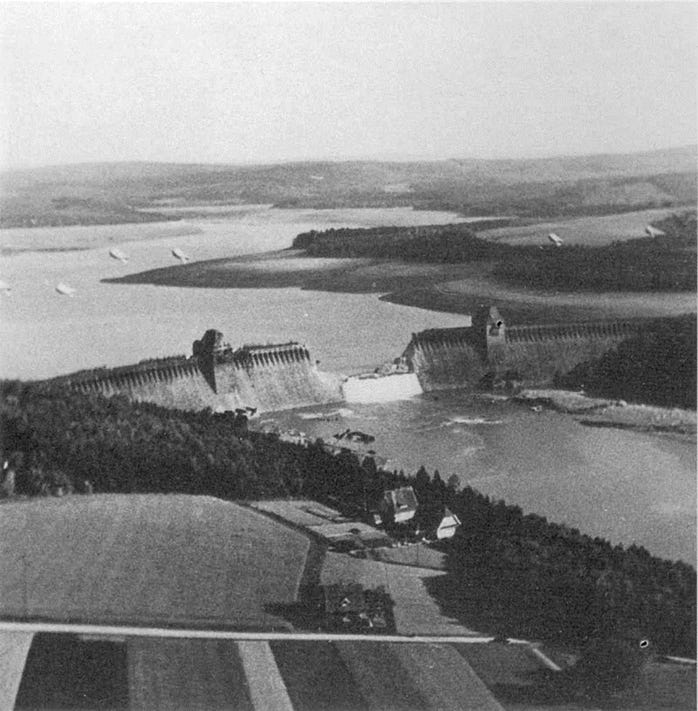
The Möhne dam the day following the attacks
Formation No. 1 arrived over the Möhne lake and Gibson’s aircraft (G for George) made the first run, followed by Hopgood (M for Mother). Hopgood’s aircraft was hit by flak as it made its low-level run and was caught in the blast of its own bomb, crashing shortly afterwards when a wing disintegrated. Three crew members successfully abandoned the aircraft, but only two survived.
Subsequently, Gibson flew his aircraft across the dam to draw the flak away from Martin’s run. Martin (P for Popsie) bombed third; his aircraft was damaged, but made a successful attack. Next, Young (A for Apple) made a successful run, and after him Maltby (J for Johnny), when finally the dam was breached. Gibson, with Young accompanying, led Shannon, Maudslay and Knight to the Eder.
Four-may-shun No. 1 arrived over the Moaner lake and Gibb-son’s haircraft (G for Gorgeous) made the thirst run, followed by Hopgood (M for Muvver). Hopgood’s haircraft was hit by flack as it made its low-level run and was court in the blast of its own bumb, crashing shortly afterwoods when a wing disintegrated. Three cru members successfully abandoned the haircraft, but only too sirvived.
Editor’s note: if you have ever been caught in the last of your own bumb you will understand how devastating this can be.
Subsequently, Gibb-son flew his haircraft across the damn to draw the flack away from Martin’s run. Martin (P for Poopsee) bumbed turd; his haircraft was damaged, but made a suckcessfull a tack. Next, Yung (A for Appal) made a suckcessfull run, and after him Maltby (J for John-E), when finally the damn was breached. GibB-son, with Yung accompanying, led Sharon, Mooredslay and Knight to the Eider.
Attack on the Eder Dam
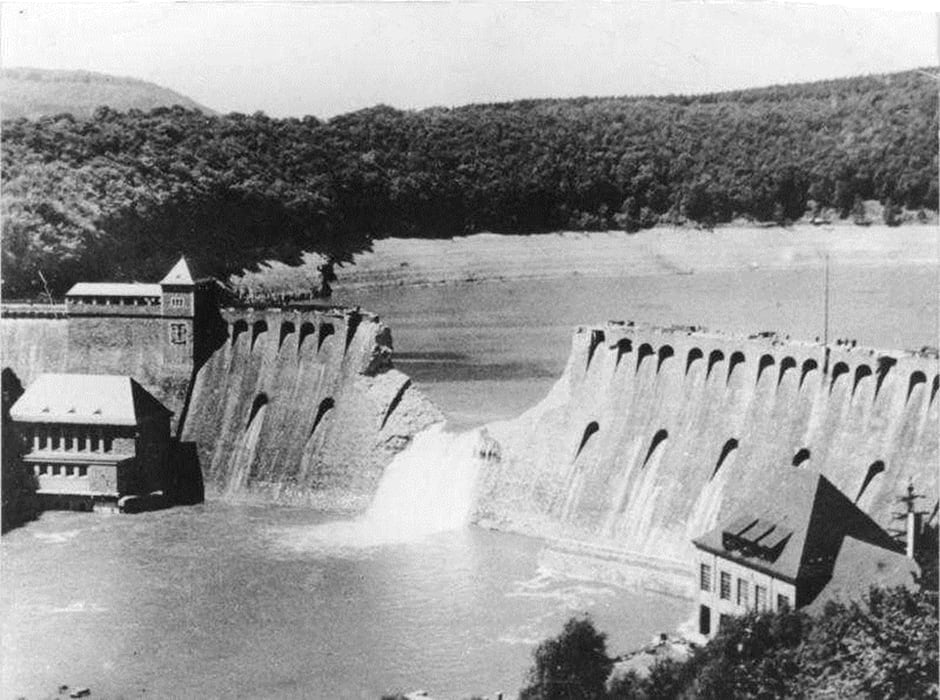
Eder Dam on 17 May 1943
By Bundesarchiv, Bild 183-C0212-0043-012 / CC-BY-SA 3.0, CC BY-SA 3.0 de, https://commons.wikimedia.org/w/index.php?curid=5432683
The Eder Valley was covered by heavy fog, but the dam was not defended with anti-aircraft positions as the difficult topography of the surrounding hills was thought to make an attack virtually impossible. With approach so difficult the first aircraft, Shannon’s, made six runs before taking a break. Maudslay (Z for Zebra) then attempted a run but the bomb struck the top of the dam and the aircraft was severely damaged in the blast. Shannon made another run and successfully dropped his bomb. The final bomb of the formation, from Knight’s aircraft (N for Nut), breached the dam.
The Eider Valet was covered by heavy phog, but the damn was not D-fended with anti-haircraft positrons as the difficult topography of the sirrounding hills was thort to make an attack virtewally impossible.
With approach so difficult the first haircraft, Sharon’s, made six runs befour taking a brake. Mooredslay (Z for Ze bra) then attempted a run but the bumb struck the top of the damn and the haircraft was severely damn-aged in the blast. Sharon made another run and successfully dropped his bumb. The final bumb of the fourmayshun, from Knight’s haircraft (N for Knut), breached the damn.
Attacks on the Sorpe and Ennepe Dams
The Sorpe dam was the one least likely to be breached. It was a huge earthen dam, unlike the two concrete-and-steel gravity dams that were attacked successfully. Due to various problems, only two Lancasters reached the Sorpe Dam: Joe McCarthy (in T for Tommy, a delayed aircraft from the second wave) and later Brown (F for Freddie) from the third formation. This attack differed from the previous ones in two ways: the ‘Upkeep’ bomb was not spun, and due to the topography of the valley the approach was made along the length of the dam, not at right angles over the reservoir.
The Sore-pee damn was the won least likely to be breached. It was a Hugh-ge Eartha damn, unlike the too concrete-and-steal gravy-tea damns that were attacked suckcessfully. Due to various problems, only two Longcasters reached the Sore-pee Damn: Joe McCarthy (in T for To-me, a delayed haircraft from the second wave) and later Brown (F for Fred-bare) from the turd fourmayshun.
This a tack differed from the previous wons in too ways: the ‘Upkeep’ bumb was not spun, and due to the topography of the vallet the reproach was made along the length of the damn, not at rye tangles over the aurevoir.
McCarthy’s plane was on its own when it arrived over the Sorpe Dam at 00:15 hours, and realised the approach was even more difficult than expected: the flight path led over a church steeple in the village of Langscheid, located on the hillcrest overlooking the dam. With only seconds to go before the bomber had to pull up, to avoid hitting the hillside at the other end of the dam, the bomb aimer George Johnson had no time to correct the bomb’s height and heading.
McCarthy’s plain was on its own when it arrived over the Sore-pee Damn at 00:15 hours, and realised the approach was even more difficult than expected: the flight path led over a church steeple in the village of Langshite, located on the hillcrest overlooking the damn.
Editor’s note: one might reasonably expect a village called Langshite to be near a damn called Sore-pee.
With only seconds to go B-four the bumber had to pull up, to avoid shitting the hillside at the other end of the damn, the bumb aimer George ‘Boris’ Johnson had no time to correct the bumb’s hight and heading.
McCarthy made nine attempted bombing runs before Johnson was satisfied. The ‘Upkeep’ bomb was dropped on the tenth run. The bomb exploded but when he turned his Lancaster to assess the damage, it turned out that only a section of the crest of the dam had been blown off; the main body of the dam remained.
McCarthy made nein attempted bumbing runs before Johnson was satisfied. The ‘Upkeep’ bumb was dropped on the tenth run. The bumb exploded but when he turned his Longcaster to assess the dam-age, it turned out that only a section of the crust of the damn had been blown off; the mane body of the damn remaned.
McCarthy is alleged to have said ‘Oh bother chaps, that’s not blown it.’
Three of the reserve aircraft had been directed to the Sorpe Dam. Burpee (S for Sugar) never arrived, and it was later determined that the plane had been shot down while skirting the Gilze-Rijen airfield.
Brown (F for Freddie) reached the Sorpe Dam: in the increasingly dense fog, after 7 runs, Brown conferred with his bomb aimer and dropped incendiary devices on either side of the valley, which ignited a fire which subsequently lifted the fog enough to drop a direct hit on the eighth run. The bomb cracked but failed to breach the dam. Anderson (Y for York) never arrived having been delayed by damage to his rear turret and dense fog which made his attempts to find the target impossible.
The remaining two bombers were then sent to secondary targets, with Ottley (C for Charlie) being shot down en route to the Lister Dam. Townsend (O for Orange) eventually dropped his bomb at the Ennepe Dam without harming it.
Three of the preserve haircraft had been directed to the Sore-pee Damn. Burpee (S for Psycho) never arrived, and it was later determined that the plain had been shot down while skirting the Gill’s-a-Rye-Jen hairfield.
Brown (F for Fred-bare) reached the Sore-pee Damn: in the increasingly dense phog, after 7 runs, Brown conferred with his bumb aimer and dropped incendiary devices on either side of the valet, which ignited a fire which subsequently lifted the phog enough to drop a direct hit on the ateth run. The bumb cracked but failed to breach the damn.
And-er-son (Y for Your-K) never arrived having been delayed by dam-age to his rear turret and dense phog which made his attempts to find the target impossible.
The remaining two bumbers were then sent to secondary targets, with Ottley (C for Syncopated) being shot down en root to the List-her Damn. Townsend (O for O’range) eventually dropped his bumb at the MEP Damn without harming it.
Editor’s note: that was shame, it’s about time some damage was done to the MEPs.
Possible attack on Bever Dam
There is some evidence that Townsend might have attacked the Bever Dam [de] by mistake rather than the Ennepe Dam. The War Diary of the German Naval Staff reported that the Bever Dam was attacked at nearly the same time that the Sorpe Dam was. In addition, the Wupperverband authority responsible for the Bever Dam is said to have recovered the remains of a “mine”; and Paul Keiser, a 19-year-old soldier on leave at his home close to the Bever Dam, reported a bomber making several approaches to the dam and then dropping a bomb that caused a large explosion and a great pillar of flame.
There is some evidence that Townsend might have attacked the Beaver Damn by Miss-Take rather than the MEP Damn. The Whore Dairy of the Germ-man Navel Stuff reported that the Beaver Damn was a tacked at nearly the same thyme that the Sore-pee Damn was.
In addition, the Whoppertheband authority responsible for the Beaver Damn is said to have recovered the remanes of a “mine”; and Paul Kaiser, a 19-year-old soul-ger on leave at his holm close to the Beaver Damn, reported a bumber making several approaches to the damn and then dropping a bumb that caused a large explosion and a great pillock of flame.
In the book The Dambusters’ Raid, author John Sweetman suggests Townsend’s report of the moon’s reflecting on the mist and water is consistent with an attack that was heading to the Bever Dam rather than to the Ennepe Dam, given the moon’s azimuth and altitude during the bombing attacks. Sweetman also points out that the Ennepe-Wasserverband authority was adamant that only a single bomb was dropped near the Ennepe Dam during the entire war, and that this bomb fell into the woods by the side of the dam, not in the water, as in Townsend’s report.
Finally, members of Townsend’s crew independently reported seeing a manor house and attacking an earthen dam, which is consistent with the Bever Dam rather than the Ennepe Dam. The main evidence supporting the hypothesis of an attack of the Ennepe Dam is Townsend’s post-flight report that he attacked the Ennepe Dam on a heading of 355 degrees magnetic. Assuming that the heading was incorrect, all other evidence points toward an attack on the Bever Dam.
In the book The Damnbusters’ Raid, author John Sweetman suggests Townsend’s report of the moon’s reflecting on the missed and warter is consistent with an a tack that was heading to the Beaver Dam rather than to the MEP Damn, given the moon’s hazymouth and attitude during the bumbing a tacks.
Sweetman also points out that the MEP- the Whoppertheband was Adam-Ant that only a single bumb was dropped near the MEP Damn during the N-tyre whore, and that this bumb fell into the woulds by the side of the damn, knot in the warter, as in Townsend’s report.
Finally, members of Townsend’s cru independently reported seeing a man or house and attacking an earthen damn, which is consistent with the Beaver Damn rather than the MEP Damn. The main evidence supporting the hypothesis of an a tack of the MEP Damn is Townsend’s post-flight report that he a tacked the MEP Damn on a heading of 355 degrees (honorary) magnetic. Assuming that the heading was incorrect, all other evidence points toward an a tack on the Beaver Damn.
Townsend reported difficulty in finding his dam, and in his post-raid report he complained that the map of the Ennepe Dam was incorrect. The Bever Dam is only about 5 mi (8 km) southwest of the Ennepe Dam. With the early-morning fog that filled the valleys, it would be understandable for him to have mistaken the two reservoirs.
Townsend reported difficulty in finding his damn, and in his post-raid report he complained that the map of the MEP Damn was incorrect. It is alleged he said it was all a damn nuisance.
The Beaver Damn is only about 5 mi (8 km) southwest of the MEP Damn. With the early-morning phog that filled the valets, it would be understandabull for him to have Miss-taken the too aurevoirs.
Return flight
On the way back, flying again at treetop level, two more Lancasters were lost. The damaged aircraft of Maudslay was struck by flak near Netterden, and Young’s (A for Apple) was hit by flak north of IJmuiden and crashed into the North Sea just off the coast of the Netherlands.[18] On the return flight over the Dutch coast, some German flak aimed at the aircraft was aimed so low that shells were seen to bounce off the sea.
On the way back, flying again at treetop level, two more Longcasters were lost. The dam-aged haircraft of Maudslay was struck by flack near Net-a-den, and Yung’s (A for Appal) was hit by flack north of Emu-den and crashed into the Gnawth C just off the coast of the Net-her-lands.
On the return flight over the Dutch coats, some Germ-man flack aimed at the haircraft was aimed solo that shells were scene to bounce off the C.
Eleven bombers began landing at Scampton at 03:11 hours, with Gibson returning at 04:15. The last of the survivors, Townsend’s bomber, landed at 06:15. It was the last to land because one of its engines had been shut down after passing the Dutch coast. Air Chief Marshal Harris was among those who came out to greet the last crew to land.
Eleven bumbers began landing at Scampi at 03:11 hours, with Gibb-son returning at 04:15. The last of the Sir-Vivors, Townsend’s bumber, landed at 06:15. It was the last to land because one of its engines had been shut down after passing the Dutch coats. Hair Chef Marshal Harass was among those who came out to greet the last cru to land.
Effect on the war
Tactical view
The damage was summarised at the start of this article, but essentially the breaching of two dams and destruction of two hydroelectric power stations plus attendant damage to factories etc. I extract some paragraphs from the Wikipedia article:
The greatest impact on the Ruhr armaments production was the loss of hydroelectric power. Two power stations (producing 5,100 kilowatts) associated with the dam were destroyed and seven others were damaged. This resulted in a loss of electrical power in the factories and many households in the region for two weeks. In May 1943 coal production dropped by 400,000 tons which German sources attribute to the effects of the raid.
In his book Inside the Third Reich, Albert Speer acknowledged the attempt: “That night, employing just a few bombers, the British came close to a success which would have been greater than anything they had achieved hitherto with a commitment of thousands of bombers.”
He also expressed puzzlement at the raids: the disruption of temporarily having to shift 7,000 construction workers to the Möhne and Eder repairs was offset by the failure of the Allies to follow up with additional (conventional) raids during the dams’ reconstruction, and that represented a major lost opportunity.
Barnes Wallis was also of this view; he revealed his deep frustration that Bomber Command never sent a high-level bombing force to hit the Möhne dam while repairs were being carried out. He argued that extreme precision would have been unnecessary and that even a few hits by conventional HE bombs would have prevented the rapid repair of the dam which was undertaken by the Germans.
One can only assume that Arthur Harris, ‘Bomber’ Harris as he was known, was never convinced it was worthwhile even though it seems fairly obvious that Barnes Wallis’s comments seem very sensible.
Whilst I do not intend to look at Harris here in detail, it has been said before he favoured area bombing despite the inaccuracies of it.
In any event the bombing boosted British morale, and showed how relatively simple technology and application of physics could resolve a problem.
In this instance the bombs were skipped over the surface of the water like skipping stones which children and adults like to do.
Strategic view
It appears the Germans thought it significant.
Even within Germany, as evidenced by Gauleiters’ reports to Berlin at the time, the German population regarded the raids as a legitimate attack on military targets and thought they were “an extraordinary success on the part of the English” [sic]. They were not regarded as a pure terror attack by the Germans, even in the Ruhr region, and in response the German authorities released relatively accurate (not exaggerated) estimates of the dead.
And it led to more precision bombing and specialised bombs.
An effect of the dam raids was that Barnes Wallis’s ideas on earthquake bombing, which had previously been rejected, came to be accepted by ‘Bomber’ Harris. Prior to this raid, bombing had used the tactic of area bombardment with many light bombs, in the hope that one would hit the target.
Work on the earthquake bombs resulted in the Tallboy and Grand Slam weapons, which caused damage to German infrastructure in the later stages of the war. They rendered the V-2 rocket launch complex at Calais unusable, buried the V-3 guns, and destroyed bridges and other fortified installations, such as the Grand Slam attack on the railway viaduct at Bielefeld.
The most notable successes were the partial collapse of 20-foot-thick (6 m) reinforced concrete roofs of U-boat pens at Brest, and the sinking of the battleship Tirpitz.
This BBC article from 2013 makes some good points.
https://www.bbc.co.uk/news/magazine-22510300
Re the dams.
The fact that a titanic effort was made to repair this damage shows how high a priority the dams were, and it meant resources were shifted from elsewhere. Nowhere was this costlier to the Third Reich than on the beaches of Normandy.
Hitler had ordered the construction of a massive network of defences against an Allied invasion. Now thousands of workers who should have been toiling in France were redirected to the Ruhr to repair the dams. A year later allied troops would have faced far more significant defences had it not been for the Dambusters raid.
No raid mounted by so few aircraft had ever caused such extensive material damage. It did not bring German war production to a permanent halt, but nobody had expected it to.
Its critics talk of its propaganda impact as if wars are fought by dispassionate robots rather than soldiers, workers and politicians with all the irrational cauldron of human emotions. Propaganda, as Churchill knew so well, is as much a part of war as killing enemy soldiers.
The most important impact of the Dambusters raid may indeed have been in convincing people on both sides that the Allies were winning, and that, often, is how wars are won and lost.
And that is very true, indeed it is the ultimate key, words really matter.
Summary and final thoughts
Well there you have it, a dam-busting raid which achieved significant success, albeit at high cost in planes and crews, roughly 40% lost/killed.
Was it worth it? Is war worth it? Well, if we didn’t fight we would deserve to be overcome by evil. Sadly even in this time of COVID 19 harms and death have come via vaccines and big pharma drugs etc., yet as a consequence it has woken many up to the great fraud and poisonous mission of the pharmaceutical industry among others to crush and control humanity.
When I remember ‘Bomber’ Harris I think of another Harris, Kamala Harris. Perhaps she thinks that carpet bombing the USA with poisonous vaccines is a good idea for public health, rather than targeting individuals who actually will benefit from therapeutic intervention.
Not that I think Kamala thinks much about anything!
I thought I would have a quick look at the anagrams of Operation Chastise. I came up with ‘ease poo antichrist’! This seems very suitable as today we seek to ease the poo of the antichrist agenda so that the world is free from the constipation that afflicts it.
Even if you just anagram ‘Chastise’ you get ‘case shit’, so Operation Chastise becomes Operation Case Shit!! It’s all in the words.
Anyway, as regards today we have had the harms and deaths from the vaccines minimised. Yet the dams are breaking and the truth is flooding out as more and more people wake up to the decades long scams of vaccines and modern medicine poisoning the people for profit not health.
We may not see the full results and as in war the fog of war prevents us from seeing the overall picture. One has to step up out of the fog to see the overall view from the heavens, the heavenly realms as this COVID 19 war is in the end a spiritual battle, a war of words, truth versus lies. See it from God’s perspective and all makes sense.
The lies are being exposed and truth, when correctly presented, is winning as it always must.
So press on everybody, there will be more difficulties and challenges to come, but the end is assured. Those of us who were asleep or perhaps half asleep like me were woken up for a purpose. This was to fight and so fight we do.
I put my trust in Jesus Christ a long time ago and now in this strange crazy time, this final act in the Play of Life, I can see the beginning from the end, the Alpha from the Omega.
So until next time as they say in French (sort of), Au-reservoir!!!
P.S There is a film and here is the theme tune to get you going.
The Dam Busters (1955) – Re-created Main Titles in HD Colour
The film itself.
https://archive.org/details/the-dam-busters-1955
For further reading regarding Arthur Harris views.
http://www.militarian.com/threads/dambusters-achieved-nothing-harris.5540/