
Why is Groningen so named?
By Baldmichael Theresoluteprotector’sson

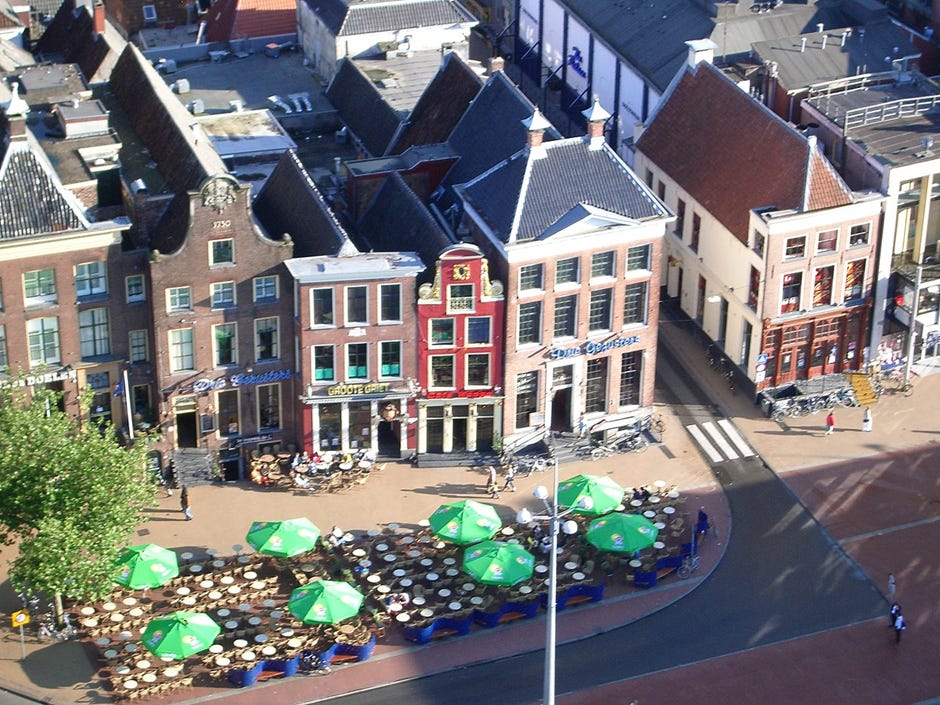
My niece spent last year at this Dutch city. She was doing a year out at the University of Groningen as part of her history of art four year course.
I didn’t visit her there more’s the pity, but what with my energy issues and current lack of a passport it was never an option.
It lies in the north of the Netherlands and is the capital city and main municipality of Groningen province.
Anyway, I thought I would have a bit of a look at the city and why it was called Groningen using Wikipedia as a basis. Text in italics from there unless otherwise stated.
https://en.wikipedia.org/wiki/Groningen
It will include my ideas and observations which may or may not be true but may keep you entertained for a short while.
Etymology
Apparently
The origin and meaning of ‘Groningen’ and its older variant, ‘Groeningen’, are uncertain.
I gather there is a folk story that exiles from Troy founded the original settlement along with a group of Phrygians (who were well-known for inventing the rephrygerator).
They were guided by a mythical leader called Gruno (or Grunius, Gryns or Grunus) and built a castle on the bank of the Hunze or Huns. The bank was believed to have been owned by a Rothschild.
There is a modern theory that
Groningen’ meant ‘among the people of Groni’ (‘Groningi’ and ‘Groninga’ in the 11th century), derived from Gronesbeke, which was the old name for a small lake near the Hunze (on the northern border of Zuidlaarderveen)
NB Zuidlaarderveen was the place, the laarder, where the local inhabitants kept all their food fresh before the Phygians arrived with their invention.
As the name Grone (variant Groene) is an old Frisian personal name, the origin may very well be in a settlement originally founded by the family of Grone and their followers, which in Frisian would be called Groninga.
I have done a post on why inga means ‘people of’, see link at end.
Another theory is that the name was derived from the word groenighe, meaning ‘green fields’.
Well, of course ‘groen’ (meaning ‘green’ in Dutch) sounds like ‘grown’ and what is green may have grown like green grass in a field.
Groenighe sounds rather like ‘Grow nigger’ and very sadly the Dutch West India Company (WIC)
transported over 300,000 slaves from the African coast to the Dutch colonies between 1621 and 1792.
In fact Groningen does contain the words ‘nigger’ and ‘negro’ in anagrams.
Anyway, the city, like all cities I suppose, started small and kept growing. It now has a population of just under 250,000.
So it has grown, and grown and grown. So regular visitors to the place have looked on said ‘Oh look it’s grown again!’
Which is why Groningen is so named.
P.S. if you like puns and word plays and want to ‘groan again’ you will find more across my site in various places. The heading THE LAUGH ORDER in my World Menu on WordPress has some.
And here’s the post I referred to in the article.
Why does ‘-ing’ at the end of a place name refer to ‘people’?
I actually spit my beer out reading "rephrygerator".
Brilliant!
I was briefly in Groeningen last year for about 4-5 hours. I was there for a day about 15 years ago as well, a seminar on minimalism in the Biblical jurisdiction being what drew me that time. This time I stopped off to check out its cycling culture. It is where the cycling culture of the Netherlands started with an election of a left wing council in the 1970s.
The main part of the city is for pedestrians and cyclists and it is quite pleasant. Of course these days many Netherlands cities are similar.